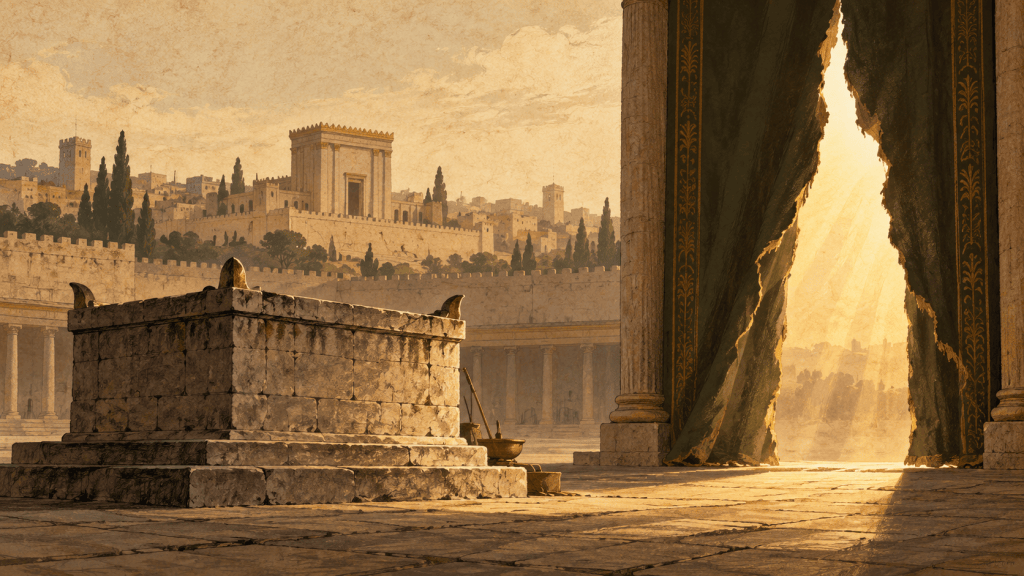
Atonement, the Book of Hebrews, and the Third Temple Question
Talk of a Third Temple in Jerusalem usually runs two separate questions together. The first is architectural and historical: could a physical sanctuary ever again stand on the Temple Mount? The second is covenantal: after Yeshua’s once-for-all offering, could Yahweh ever again authorize animal blood as His appointed means of atoning for sin?
These are not the same question, and treating them as one causes a good deal of confusion. Popular prophecy teaching often assumes that a rebuilt temple would bring with it a divinely sanctioned return of the altar. Some readers push back by insisting that no temple could ever be built at all. Both moves blur the issue. Scripture has a great deal to say about the second question and much less to say about the first.
This article argues that the apostolic writings, and the Book of Hebrews above all, close the door firmly on any future return of atoning sacrifice under divine sanction. They leave the question of a physical building far more open. The hardest counterevidence, especially Ezekiel’s temple vision, deserves a careful hearing, and it gets one below.
Two Different Questions
The distinction needs to be clear from the start.
The architectural question asks whether human beings could construct a sanctuary on Mount Moriah and resume rituals there. That depends on human initiative, political circumstances, and how one reads several prophetic texts (Daniel 9:27; Matthew 24:15; 2 Thessalonians 2:4; Revelation 11:1–2). Sincere interpreters disagree about it.
The covenantal question asks whether Yahweh would ever again accept animal blood as a means of removing sin and reconciling His people to Himself. This depends on what Scripture teaches about Yeshua’s priesthood and offering, and here the apostolic writings speak directly.
A building could stand without divine endorsement. Scripture records plenty of religious structures that Yahweh never approved. The existence of a building would settle nothing about the covenantal question. Most of this article concerns that covenantal question, because that is where the biblical evidence is concentrated.
What the Levitical Sacrifices Actually Did
Any honest discussion has to begin by taking the sacrificial system seriously. The offerings of Leviticus were not a mistake that Yahweh later abandoned. They were not pagan leftovers or empty ritual either. They were a holy provision given so that a holy God could dwell among a frail and often impure people without consuming them.
The purification offering (chattat, חַטָּאת), often translated “sin offering,” dealt with the defilement that human sin and impurity brought upon the sanctuary. Leviticus treats that defilement as real. Left unaddressed, it threatened Israel’s continued access to Yahweh’s presence (Leviticus 15:31; 16:16). Blood applied to the altar and before the veil purged the sanctuary. The verb for this work is kipper (כִּפֶּר), usually translated “make atonement.”
The offerings also brought genuine forgiveness within the terms of the Sinai covenant. For sins committed unintentionally, Leviticus repeatedly promises: “So the priest shall make atonement for them, and it shall be forgiven them” (Leviticus 4:20; cf. 4:26, 31, 35). The guilt offering (asham, אָשָׁם) addressed sacrilege and required restitution (Leviticus 5:14–6:7). The peace offering (shelamim, שְׁלָמִים) was a shared meal of restored fellowship between Yahweh, the priests, and the worshiper (Leviticus 3; 7:11–15).
The rationale for the blood rites appears in Leviticus 17:11:
“For the life of the flesh is in the blood, and I have given it to you upon the altar to make atonement for your souls; for it is the blood that makes atonement for the soul.”
The key phrase is “I have given it to you.” Sacrifice was not a human technique for manipulating God. It was a gift of grace, appointed by Yahweh Himself for Israel’s life with Him.
Any argument that the sacrifices have ended must therefore be an argument about fulfillment, not about failure. That is exactly the argument Hebrews makes.
Why Hebrews Says They Had to Be Repeated
For the author of Hebrews, the clearest sign of the system’s limits was its constant repetition.
“For the law, having a shadow of the good things to come, and not the very image of the things, can never with these same sacrifices, which they offer continually year by year, make those who approach perfect.” (Hebrews 10:1)
The reasoning is straightforward. If the offerings had achieved a final cleansing, they would have stopped. Worshipers would no longer carry a “consciousness of sins” (Hebrews 10:2). Instead, Yom Kippur came around every year, and the author calls it “a reminder of sins every year” (10:3).
Hebrews is careful here. It does not say the animal sacrifices did nothing. It grants that “the blood of bulls and goats and the ashes of a heifer” really did sanctify “for the purifying of the flesh” (9:13). They achieved what they were appointed to achieve within their sphere, which was outward, ritual cleansing for participation in the covenant community. What they could not do was purge the conscience: “For it is not possible that the blood of bulls and goats could take away sins” (10:4).
The Law was a skia (σκιά), a shadow, not the eikōn (εἰκών), the substantial form of the realities themselves. A shadow is real. It has a shape, and it tells you something true about the object casting it. But nobody mistakes the shadow for the object.
“Once for All”: Hapax and Ephapax
Against this background of endless repetition, Hebrews describes Yeshua’s offering with two related Greek words.
Hapax (ἅπαξ) means “once,” something that happens a single time. Ephapax (ἐφάπαξ) is its emphatic form: “once for all,” a single act that needs no supplement or repetition. The word itself does not carry the argument. The way Hebrews uses it does. The author sets it again and again against the daily and yearly repetition of the Levitical order:
- Yeshua “does not need daily, as those high priests, to offer up sacrifices… for this He did once for all [ephapax] when He offered up Himself” (Hebrews 7:27).
- “Not with the blood of goats and calves, but with His own blood He entered the Most Holy Place once for all [ephapax], having obtained eternal redemption” (9:12).
- “Now, once [hapax] at the end of the ages, He has appeared to put away sin by the sacrifice of Himself” (9:26).
- As people die once, “so Messiah was offered once [hapax] to bear the sins of many” (9:27–28).
- “We have been sanctified through the offering of the body of Yeshua Messiah once for all [ephapax]” (10:10).
The comparison in 9:27–28 is especially telling. Yeshua’s offering is as unrepeatable as a human death. It is not one sacrifice in a continuing series. It stands at “the end of the ages,” at the turning point of redemptive history.
Standing Priests and a Seated Priest
Hebrews then draws a contrast that is almost visual:
“And every priest stands ministering daily and offering repeatedly the same sacrifices, which can never take away sins. But this Man, after He had offered one sacrifice for sins forever, sat down at the right hand of God… For by one offering He has perfected forever those who are being sanctified.” (Hebrews 10:11–12, 14)
The Levitical priests stood because their work was never finished. The furnishings Moses was commanded to build included an ark, a table, a lampstand, and altars, but nowhere for a priest to sit. Messiah sat down, and in Hebrews that posture carries the whole argument. His seated position at the Father’s right hand is the Bible’s own picture of a completed atoning work.
“There Is No Longer an Offering for Sin”: Hebrews 10:18
The argument of Hebrews reaches its verdict in a single sentence:
“Now where there is remission of these, there is no longer an offering for sin.” (Hebrews 10:18)
Each part of the sentence matters.
“These” points back to the verse just before it, where Hebrews quotes the new covenant promise of Jeremiah 31:34: “Their sins and their lawless deeds I will remember no more” (Hebrews 10:17). The “remission” (aphesis, ἄφεσις) is the release and cancellation of those sins under the new, or renewed, covenant.
“No longer” (ouketi, οὐκέτι) marks the end of something that once existed. The thing that has ended is a prosphora peri hamartias, an “offering for sin.” The phrase peri hamartias (“for sin”) is the standard way the Greek Old Testament renders the chattat, the sin or purification offering of Leviticus. Hebrews has just used the same wording in quoting Psalm 40 (Hebrews 10:6, 8).
The logic is not psychological. Hebrews is not saying that believers merely no longer feel a need to bring animals. The claim is covenantal: a sin offering exists to deal with sin that remains on the record. Where Yahweh has promised to remember sins no more, the purpose that sin offerings served has been fully met. A renewed, divinely authorized sin offering would imply that something remained unaddressed. That is exactly what the new covenant promise denies.
This is the load-bearing text for the whole question. It is explicit, it sits in the most sustained discussion of sacrifice in the apostolic writings, and it uses the technical language of the sin offering itself.
A Change of Priesthood
Hebrews ties the end of atoning sacrifice to a change of priesthood.
“Therefore, if perfection were through the Levitical priesthood (for under it the people received the law), what further need was there that another priest should rise according to the order of Melchizedek, and not be called according to the order of Aaron? For the priesthood being changed, of necessity there is also a change of the law.” (Hebrews 7:11–12)
The argument runs through Psalm 110:4. Centuries after Sinai, Yahweh swore by oath that David’s Lord would be “a priest forever according to the order of Melchizedek.” Hebrews reasons that if the Aaronic priesthood had been able to bring about teleiōsis (τελείωσις), the perfected relationship with God it was aiming at, there would have been no need to announce a different priestly order.
Yeshua came from Judah, “of which tribe Moses spoke nothing concerning priesthood” (7:14). Under the Sinai legislation only Aaron’s line could serve at the altar (Numbers 18:7). Hebrews states the consequence plainly: “if He were on earth, He would not be a priest, since there are priests who offer the gifts according to the law” (8:4). His priesthood rests “not according to the law of a fleshly commandment, but according to the power of an endless life” (7:16).
For this reason Hebrews speaks of a metathesis (μετάθεσις), a transfer or change, of the law that governed priesthood (7:12). Readers from a Torah-honoring background often feel uneasy at this point, and it helps to be precise. Hebrews does not say Torah was evil or defective in its design. Paul calls the Law “holy, and the commandment holy and just and good” (Romans 7:12). The change Hebrews describes concerns the regulations tied to the Aaronic priesthood and its offerings. Hebrews calls those “fleshly ordinances imposed until the time of reformation” (9:10).
Hebrews 8:13 then applies Jeremiah’s promise: “In that He says, ‘A new covenant,’ He has made the first obsolete. Now what is becoming obsolete and growing old is ready to vanish away.” Interpreters disagree about how much of the Sinai order that verse covers, and that larger debate is beyond this article. On the narrower question here, the priesthood and its offerings for sin, Hebrews leaves no ambiguity. That administration has given way to Messiah’s.
The Earthly Copy and the Heavenly Sanctuary
Hebrews also grounds its argument in the structure of the sanctuary itself. The tabernacle was built “according to the pattern shown you on the mountain” (Hebrews 8:5, quoting Exodus 25:40). It was a copy and shadow of heavenly realities, an “earthly sanctuary” (9:1). While that first tabernacle stood as a functioning institution, “the way into the Holiest of All was not yet made manifest” (9:8). The high priest entered only once a year, and never without blood (9:7).
Messiah’s ministry is located somewhere else entirely:
“For Messiah has not entered the holy places made with hands, which are copies of the true, but into heaven itself, now to appear in the presence of God for us.” (Hebrews 9:24)
Hebrews even says that the heavenly things themselves needed purifying “with better sacrifices than these” (9:23). The sanctuary-cleansing work that Leviticus assigned to animal blood in the earthly copy, Messiah accomplished in the true sanctuary with His own blood.
This is why Hebrews directs believers upward rather than toward Jerusalem. The invitation is: “Let us therefore come boldly to the throne of grace” (4:16). And again:
“Therefore, brethren, having boldness to enter the Holiest by the blood of Yeshua, by a new and living way which He consecrated for us, through the veil, that is, His flesh… let us draw near with a true heart in full assurance of faith.” (Hebrews 10:19–22)
The Synoptic Gospels record that at Yeshua’s death “the veil of the temple was torn in two from top to bottom” (Matthew 27:51; Mark 15:38; Luke 23:45). Hebrews does not cite the Gospel event directly. But its image of access “through the veil, that is, His flesh” fits naturally with it. A reconstructed veil and a restored priesthood offering atoning blood would picture again the very barrier that Hebrews says has been opened.
What AD 70 Did and Did Not Prove
Yeshua foretold the Temple’s destruction: “not one stone shall be left here upon another, that shall not be thrown down” (Matthew 24:2; cf. Luke 19:41–44). Within a generation, the prediction was fulfilled. In AD 70, after the Roman siege under Titus, the sanctuary burned. Josephus reports that the daily offering (tamid) had already failed some weeks earlier, on the seventeenth of Panemus (Tammuz), because there were no longer men to offer it. The Mishnah also remembers the seventeenth of Tammuz as the day the tamid ceased.
Jewish communities responded to the loss in different ways. According to a well-known tradition in Avot de-Rabbi Natan, Rabbi Yochanan ben Zakkai comforted a disciple weeping over the ruins by pointing to Hosea 6:6, “For I desire mercy and not sacrifice.” Acts of lovingkindness, he taught, atone as the altar once did. Rabbinic tradition also connected the daily prayer services to the times of the daily offerings. Judaism reorganized its life around Torah, prayer, and deeds of kindness in the absence of the altar.
For the followers of Yeshua, the destruction confirmed what He had spoken, and it fit what Hebrews had already taught. It is important not to get the order backwards. The apostolic argument that atoning sacrifice has ended does not rest on Roman armies. Hebrews argues from Yeshua’s priesthood and offering, not from military events. The case against a future return of atoning sacrifice would stand even if the Temple had never fallen. The events of AD 70 illustrate the conclusion. They do not establish it.
Could a Third Temple Be Built?
This brings us back to the architectural question, where Scripture speaks less directly.
Nothing in Hebrews says, “No building will ever again stand in Jerusalem.” Several texts are read by many interpreters as implying a future temple structure. Paul speaks of the “man of sin” who “sits as God in the temple of God, showing himself that he is God” (2 Thessalonians 2:4). Revelation 11:1–2 describes the measuring of a temple, and Yeshua speaks of the “abomination of desolation” standing in the holy place (Matthew 24:15). Whether these point to a future physical building, to the Second Temple before AD 70, or to something symbolic is widely debated.
Broadly, interpreters fall into four camps:
- A literal future temple. Common in dispensational premillennialism and in Orthodox Jewish expectation, this view holds that a physical temple will be rebuilt before Messiah’s return. It often identifies Ezekiel 40–48 with a later millennial sanctuary.
- The community as temple. Common in Reformed and amillennial traditions, this view holds that the New Testament deliberately redefines the temple as Messiah’s body, the Spirit-indwelt people of God (1 Corinthians 3:16–17; Ephesians 2:19–22).
- The new creation as temple. This view sees every temple theme reaching its goal in the New Jerusalem of Revelation 21–22.
- Ezekiel as an idealized restoration vision. Old Testament scholars such as Daniel Block and Steven Tuell read Ezekiel 40–48 primarily as a vision addressed to the exiles, portraying the return of Yahweh’s glory and a purified order of worship rather than an architectural forecast for a distant future.
For the purposes of this article, the key point holds whichever view one takes. The construction of a physical temple would not show that Yahweh had reinstated animal sacrifice as His appointed means of atonement. Groups in Jerusalem today are actively preparing for a temple, and a building could conceivably be raised if circumstances allowed. Paul’s own warning in 2 Thessalonians 2:4 assumes that a “temple of God” could become the setting for rebellion rather than a sign of divine approval. What a building would prove is human initiative. What Yahweh accepts for sin is settled by His word.
The Hardest Text: Ezekiel 40–48
Ezekiel’s temple vision is the most serious challenge to the conclusion above, and it deserves an honest hearing.
What Ezekiel Actually Describes
Twenty-five years into the Babylonian exile, Ezekiel is brought in a vision to a very high mountain in Israel. There a guide measures a temple in detail (Ezekiel 40:1–4). The vision includes:
- tables for slaughtering the burnt offering, the sin offering, and the guilt offering (40:39; cf. 42:13);
- a seven-day consecration of the altar with bulls and goats, to cleanse it and make atonement for it (43:18–27);
- a priesthood limited to the sons of Zadok (44:15–16);
- a figure called “the prince” (ha-nasi), who “shall prepare the sin offering, the grain offering, the burnt offering, and the peace offerings to make atonement for the house of Israel” (45:17; cf. 45:15, 20).
The verb is le-khapper (לְכַפֵּר), “to make atonement,” the same technical language used throughout Leviticus. Anyone who wants to use Ezekiel as a straightforward blueprint for the future has to reckon with the fact that Ezekiel describes atoning offerings, not merely celebratory ones.
The Rabbis Noticed the Problem
The difficulty is ancient. Ezekiel’s legislation does not match the Torah of Moses. For example, Ezekiel prescribes for the new moon one young bull, six lambs, and a ram (Ezekiel 46:6). Numbers requires two young bulls, one ram, and seven lambs (Numbers 28:11). Ezekiel’s vision mentions no high priest, no ark, and no Day of Atonement in the form Leviticus 16 prescribes.
The Babylonian Talmud preserves a memory of how seriously the sages took this. It says the book of Ezekiel would have been withdrawn from use because its words contradicted the Torah, had it not been for Hananiah ben Hezekiah. He is said to have gone through three hundred jars of lamp oil working out explanations (Shabbat 13b). Even so, the Talmud admits that some of the difficulties remained unresolved. In discussing one of them, Rabbi Yochanan says that this passage Elijah will interpret in the future (Menachot 45a).
This matters for a modern reader. The oldest Jewish interpreters of Ezekiel did not find his vision easy to read as a literal program. The claim that Ezekiel “plainly” predicts a future return of the Mosaic cultus runs into trouble at the Mosaic level, before the New Testament is even considered.
Four Ways of Reading the Vision
The memorial view. Many dispensational interpreters have argued that future sacrifices would look back to the cross, much as the Lord’s Supper does, rather than atone. This view has a real motive: it tries to honor both Ezekiel and Hebrews. But it has no basis in Ezekiel’s own words. Ezekiel never calls these offerings memorials. He calls them sin offerings and guilt offerings and states that their purpose is le-khapper, to make atonement. The memorial label is a harmonizing device brought to the text, not something drawn from it.
The ceremonial-purification view. A more careful dispensational answer, argued by Jerry Hullinger, holds that Ezekiel’s sacrifices would not touch eternal salvation at all. Instead, they would remove ceremonial defilement so that a holy God could dwell among people who are still mortal. This is the strongest form of the literal reading. It takes Ezekiel’s atonement language seriously, and it rightly notes that even under Moses the sin offering often dealt with ritual impurity rather than moral guilt. Hebrews itself admits that animal blood purified “the flesh” (9:13).
The difficulty is that Hebrews treats the entire sanctuary-cleansing function as part of what Messiah fulfilled. The copies were purified with animal blood, but “the heavenly things themselves with better sacrifices than these” (9:23). The fleshly ordinances were imposed “until the time of reformation” (9:10). Hebrews 10:18 speaks in the technical language of the sin offering, the very category Ezekiel prescribes. To reinstate the chattat after the cross, even for ceremonial ends, is to return to the regulations Hebrews says were imposed only until a set time. The view is serious, but it has to swim against the current of Hebrews’ argument.
The idealized restoration view. Ezekiel’s vision was given to exiles, and it is framed by a call to repentance: the house is shown to Israel so that they may be ashamed of their iniquities and keep its ordinances (Ezekiel 43:10–11). On this reading, associated with scholars such as Block and Tuell, the vision is an idealized portrait of restored worship and returning glory, addressed first to its original audience. It fits the historical setting well. It has more difficulty with the vision’s cosmic features, such as the river that flows from the temple and makes the Dead Sea fresh (47:1–12).
The visionary or new-creation view. Here Ezekiel uses the only vocabulary of holiness available to a priest-prophet of his day: altar, boundary, priesthood, and offering. With it he portrays Yahweh dwelling forever with a purified people. This reading has strong support from Revelation. John takes up Ezekiel’s imagery, including the high mountain, the measured city, the gates named for the twelve tribes, and the river of life. Then he says: “But I saw no temple in it, for the Lord God Almighty and the Lamb are its temple” (Revelation 21:22).
Weighing Them
No reading of Ezekiel 40–48 is free of difficulty, and humility is warranted. But the question is which reading best accounts for all the evidence. A view that requires Yahweh to reauthorize sin offerings has to set aside the most direct teaching on the subject in the New Testament. The visionary and idealized readings do justice to Ezekiel’s genre, to its differences from Moses, to the rabbinic struggle with it, and to the way Revelation takes it up. On balance, they are the stronger explanation. Visionary prophecy should be read in light of explicit apostolic teaching, not used to overturn it.
Zechariah 14 and the Holiness of Cooking Pots
Zechariah 14:16–21 is also cited in favor of future sacrifices. After a final conflict over Jerusalem, survivors from the nations go up year by year “to worship the King, the LORD of hosts, and to keep the Feast of Tabernacles.” Then the chapter closes:
“In that day ‘HOLINESS TO THE LORD’ shall be engraved on the bells of the horses. The pots in the LORD’s house shall be like the bowls before the altar. Yes, every pot in Jerusalem and Judah shall be holiness to the LORD of hosts. Everyone who sacrifices shall come and take them and cook in them.” (Zechariah 14:20–21)
The passage does mention sacrifice. The participle zovchim (“those who sacrifice”) comes from zavach, a verb most often associated with slaughter offerings whose meat was shared and eaten. But the focus of the passage is not atonement. It is the spread of holiness. The inscription once engraved on the high priest’s turban (Exodus 28:36) now appears on horses’ bells. Ordinary cooking pots become as holy as the altar’s vessels. The line between sacred and common is dissolving.
Zechariah says nothing about sin offerings purging guilt. It describes worship and consecration in the prophetic vocabulary of its own era. Malachi uses similar language when he foresees that “in every place incense shall be offered to My name, and a pure offering” (Malachi 1:11). The apostolic writings speak of incense as the prayers of the saints (Revelation 5:8; 8:3–4) and of believers offering “spiritual sacrifices acceptable to God through Yeshua Messiah” (1 Peter 2:5). Zechariah 14 is a real text about future worship, but it is not evidence for a return of atoning sacrifice.
Daniel 9 and the End of Sacrifice
Daniel’s prophecy of the seventy weeks names a sixfold purpose: “to finish the transgression, to make an end of sins, to make reconciliation for iniquity, to bring in everlasting righteousness, to seal up vision and prophecy, and to anoint the Most Holy” (Daniel 9:24). The phrase “make reconciliation for iniquity” again uses le-khapper. The prophecy goes on to say that “Messiah shall be cut off” (9:26). It then says that sacrifice and offering will be brought to an end in the middle of the final week (9:27).
The identity of the one who ends the sacrifices in 9:27 is disputed:
- The messianic reading, held by a long line of interpreters from the early church through Calvin and into the twentieth century with E. J. Young, sees Messiah as the one who confirms the covenant and, by His death, brings sacrifice to an end.
- The future-antichrist reading, common in dispensational teaching, sees a coming ruler who makes a treaty and later halts sacrifices in a rebuilt temple.
- The Maccabean reading, standard among historical-critical scholars, applies the passage to Antiochus IV, who stopped the daily offering in 167 BC.
The grammar is genuinely debated. The nearest antecedent for “he” in verse 27 is “the prince who is to come” in verse 26, which counts against the messianic reading. Daniel 9 therefore cannot bear the weight of the argument by itself. What can be said is more modest. Daniel places atonement for iniquity and everlasting righteousness within the same prophetic horizon as Messiah’s being cut off, and nothing in the passage anticipates a later renewal of sacrifice as God’s means of reconciliation. Daniel supports the conclusion. It does not carry it.
Paul in the Temple: Acts 21
The most serious historical objection comes from the apostles themselves. If Yeshua’s offering ended atoning sacrifice, why did the early believers keep worshiping in the Temple? Why did Paul pay for offerings?
The believers in Jerusalem met daily in the Temple courts (Acts 2:46; 3:1). Around AD 57, James and the elders told Paul that thousands of Jewish believers were “all zealous for the law” and had heard that Paul taught Jews to forsake Moses (Acts 21:20–21). To answer the rumor, Paul joined four men who had taken a vow, paid their expenses, and was purified with them:
“Then Paul took the men, and the next day, having been purified with them, entered the temple to announce the expiration of the days of purification, at which time an offering should be made for each one of them.” (Acts 21:26)
The shaving of heads points to a Nazirite vow (Numbers 6). That is the usual reading, though Acts does not name it. At its completion the Torah required a burnt offering, a peace offering, and a chattat, a sin or purification offering (Numbers 6:14). Paul, then, paid for offerings that included a chattat. That fact should be acknowledged plainly rather than explained away.
Several considerations keep it in proportion:
- The apostles did not treat faith in Yeshua as leaving Israel. Their continued Temple worship shows that they did not regard Temple participation as inherently a betrayal of Messiah. Readers who assume otherwise are reading a later separation back into the text.
- The vow was voluntary devotion, not a means of justification. Paul’s letters are unambiguous that no one is justified by works of the law but through faith in Messiah (Romans 3:20–28; Galatians 2:16). Nothing in Acts suggests Paul or the Jerusalem elders thought these offerings secured forgiveness before God.
- This was a transitional generation. Hebrews describes the first covenant’s order as “becoming obsolete and growing old,” ready to vanish (8:13). It had not yet vanished. The institutions of the Temple were still standing when Acts 21 took place, and they would remain for a little more than a decade.
The fair conclusion is this: Acts shows that the first Jewish believers kept participating in the Temple’s life during those years. Acts never teaches that animal blood retained covenantal power to remove sin. The question this article addresses is whether Yahweh would authorize such sacrifices as the means of atonement after Messiah. Acts 21 does not answer yes, and Hebrews answers no.
“Everlasting Statutes”?
Another objection points to Torah’s language of permanence. The Day of Atonement is “an everlasting statute” (Leviticus 16:34). Aaron’s sons were given “an everlasting priesthood” (Exodus 40:15). Jeremiah promises that the Levitical priests will never lack a man to offer burnt offerings (Jeremiah 33:18).
The Hebrew olam often means “lasting,” “age-long,” or “for the duration of an era.” It does not necessarily mean endless in a philosophical sense, although context must decide in each case. More decisively, Hebrews knows that Aaron’s priesthood was called perpetual, and still says the priesthood has been changed (7:12). Its answer is not that the promise was broken. The answer is that Yahweh’s later oath in Psalm 110:4 establishes a priesthood that truly is “forever,” held by One who “continues forever” and “has an unchangeable priesthood” (Hebrews 7:24). Promises like Jeremiah 33 raise real interpretive questions. But the New Testament’s consistent answer is that they find their fulfillment in Messiah’s priesthood, not in a return of the Levitical altar.
Where the Biblical Story Ends
When the evidence is traced across Scripture, the direction of travel is striking. The sacred categories once divided among a building, a victim, and a priest gather into the person of Yeshua.
He is the temple. “Destroy this temple, and in three days I will raise it up,” He said, and John explains: “He was speaking of the temple of His body” (John 2:19, 21). “In this place there is One greater than the temple” (Matthew 12:6).
He is the priest, holy, undefiled, exalted above the heavens, able “to save to the uttermost those who come to God through Him, since He always lives to make intercession for them” (Hebrews 7:25–26).
He is the offering: “Messiah, our Passover, was sacrificed for us” (1 Corinthians 5:7). His blood is “the blood of the new covenant, which is shed for many for the remission of sins” (Matthew 26:28). God set Him forth as a hilastērion through faith in His blood (Romans 3:25). Translators render that word as “propitiation” or “mercy seat,” and either way it draws on the language of Yom Kippur.
His people, in turn, become a living temple. “Do you not know that you are the temple of God and that the Spirit of God dwells in you?” (1 Corinthians 3:16). In Messiah the whole building “grows into a holy temple in the Lord… a dwelling place of God in the Spirit” (Ephesians 2:21–22). Believers are “living stones… a holy priesthood, to offer up spiritual sacrifices” (1 Peter 2:5). These passages do not by themselves rule out a stone building in Jerusalem. They do show where Yahweh’s dwelling presence is now found.
The story ends in the New Jerusalem, and there John sees no temple at all (Revelation 21:22). The city is a perfect cube (21:16), the same shape as the Most Holy Place of Solomon’s temple (1 Kings 6:20). The whole city has become the Holy of Holies. No veil remains, because nothing defiled remains (21:27): “They shall see His face, and His name shall be on their foreheads” (22:4). Whatever one believes about an intermediate millennial period, Scripture’s final picture contains no temple building and no altar of animal sacrifice.
Sacrifice Versus Atoning Sacrifice
One further distinction helps to sharpen the conclusion. The Torah never treated all offerings as identical. Alongside the sin and guilt offerings were offerings of thanksgiving (todah), fellowship (shelamim), freewill gifts (nedavah), and grain (minchah). Their purpose was gratitude, devotion, and shared celebration rather than expiation.
Ancient Judaism recognized this difference. A tradition preserved in Leviticus Rabbah (9:7) teaches that in the age to come all sacrifices will cease except the thanksgiving offering, and all prayers will cease except the prayer of thanksgiving. The sages understood that when sin is finally resolved, the offerings for sin lose their purpose, while thanksgiving remains.
This distinction clarifies the debate in two directions. On one side, whether any non-atoning expression of worship could exist in a future age is a genuinely open question, and it should not be confused with the question of atonement. On the other side, the distinction does not rescue a literal reading of Ezekiel, because Ezekiel does not limit himself to thanksgiving and fellowship offerings. He prescribes sin and guilt offerings and says their purpose is to make atonement. That is precisely the category Hebrews 10:18 says has come to an end.
Weighing the Evidence
When the evidence is sorted by strength, the picture becomes clear.
What Scripture teaches directly:
- Yeshua’s offering was once for all and does not need repeating (Hebrews 7:27; 9:12, 26–28; 10:10).
- The repeated animal sacrifices could never perfect the conscience (Hebrews 9:9; 10:1–4).
- The priesthood has passed from Aaron’s line to the Melchizedekian priesthood of Messiah (Psalm 110:4; Hebrews 7:11–24).
- Believers have open access into the Holiest through Messiah’s blood (Hebrews 10:19–22).
- Where the new covenant’s forgiveness has been granted, “there is no longer an offering for sin” (Hebrews 10:18).
What follows as a necessary inference:
- Yahweh will not again authorize animal sacrifice as a means of atoning for sin. To do so would contradict the terms of the new covenant and treat Messiah’s offering as incomplete (Hebrews 10:17–18, 29).
- The Levitical system was not a failure. It fulfilled its God-given purpose as a true but provisional shadow, and it supplies the vocabulary through which Messiah’s work is understood.
What remains open or disputed:
- Whether a physical temple will be built in Jerusalem, and what role it might play in end-time events.
- The genre and intended fulfillment of Ezekiel 40–48.
- The identity of the one who ends the sacrifices in Daniel 9:27.
- Whether any non-atoning offering could have a place in a future age.
The strongest opposing arguments, Ezekiel’s atonement language and Paul’s conduct in Acts 21, are real and should not be waved away. Neither overturns the direct teaching of Hebrews. Ezekiel is visionary literature whose relation to Mosaic law troubled Jewish interpreters long before the apostles. Acts 21 describes the practice of a transitional generation, and it never presents animal blood as a means of justification.
Conclusion: “We Have an Altar”
If Yeshua has offered Himself once for all, obtained eternal redemption, entered heaven itself, and sat down at the right hand of the Majesty on high, then animal sacrifice can never again become Yahweh’s appointed means of atonement. To say otherwise would be to treat His blood as provisional and His finished work as unfinished. It would reopen the question Hebrews 10:18 closes: “there is no longer an offering for sin.”
The Third Temple question is therefore smaller than it is often made to seem. Stones may yet be laid on Mount Moriah. Rituals may yet be resumed. Scripture does not tell us with certainty what the future holds for that hill. What it does tell us is that no such building could change what Yahweh has already accepted, once and for all, for the forgiveness of sins.
Hebrews says it simply: “We have an altar from which those who serve the tabernacle have no right to eat” (Hebrews 13:10). That altar is not waiting to be rebuilt. The Priest who serves it has already sat down, and the way into the Holiest stands open to everyone who draws near to Yahweh through Him.
Sources and Notes
Scripture quotations follow the New King James Version, with “Yeshua” substituted for “Jesus” and “Messiah” for “Christ.” In Zechariah 14, “LORD” in small capitals represents the divine name, Yahweh.
Ancient sources
- Josephus, Jewish War 6.94 (6.2.1), on the failure of the daily offering during the siege.
- Mishnah Ta’anit 4:6, on the cessation of the tamid on the seventeenth of Tammuz.
- Avot de-Rabbi Natan (Version A), ch. 4, on Rabbi Yochanan ben Zakkai and Hosea 6:6.
- Babylonian Talmud, Berakhot 26b, on the correspondence between the daily prayers and the daily offerings.
- Babylonian Talmud, Shabbat 13b, on Hananiah ben Hezekiah and the book of Ezekiel.
- Babylonian Talmud, Menachot 45a, on unresolved contradictions between Ezekiel and the Torah.
- Leviticus Rabbah 9:7, on the thanksgiving offering in the age to come.
Modern scholarship
- Daniel I. Block, The Book of Ezekiel: Chapters 25–48, New International Commentary on the Old Testament (Eerdmans, 1998).
- Steven S. Tuell, The Law of the Temple in Ezekiel 40–48 (Scholars Press, 1992).
- Jerry M. Hullinger, “The Problem of Animal Sacrifices in Ezekiel 40–48,” Bibliotheca Sacra 152 (1995).
- E. J. Young, The Prophecy of Daniel (Eerdmans, 1949).


Leave a comment