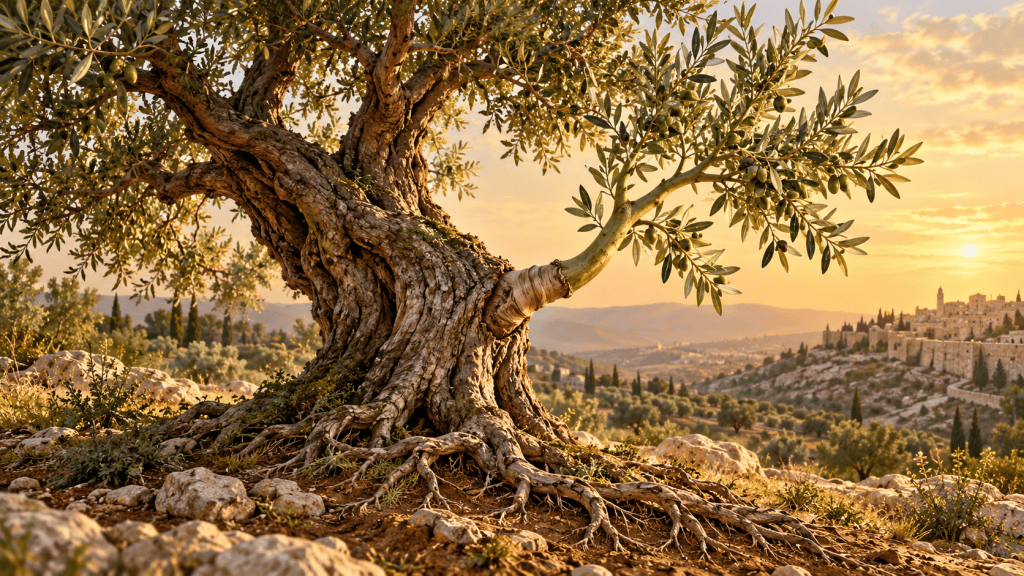
In Romans 11:16-24 Paul compares the people of God to a cultivated olive tree. Some branches are broken off, wild branches are grafted in, and the broken branches can be grafted back. The image is short, but nearly every part of it carries weight in debates over Israel, the Gentiles, and the covenants. This article takes each part in turn: the root, the natural branches, the wild branches, the breaking off, the grafting in, and the restoration. It asks what Paul says, what he clearly means, and where honest readers still differ.
The Tree in Its Setting
Paul introduces the olive tree to answer a question he raises at the start of the chapter: "I ask, then, has God rejected his people? By no means!" (Rom. 11:1). He points to himself as an Israelite, to the remnant chosen by grace (11:5), and to the hardening that has come upon the rest (11:7-10). The olive tree then explains how Gentile believers fit into the story without displacing the people Paul has just defended.
The image was not invented from nothing. Israel’s prophets already spoke of the nation as an olive tree. Jeremiah recalls that Yahweh once called Israel "a green olive tree, beautiful with good fruit," and then announces that its branches will be consumed (Jer. 11:16). Hosea promises that Israel’s beauty will one day be "like the olive" (Hos. 14:6). Paul is working with a picture his Jewish readers would have recognized, and he applies it to the moment when some Israelites have believed in Yeshua, many have not, and Gentiles are coming in.
The most important thing to notice at the outset is that Paul speaks of one tree. He does not describe two trees, and he does not describe the old tree being uprooted and replaced. Everything else in the passage depends on that.
The Root
"If the dough offered as firstfruits is holy, so is the whole lump, and if the root is holy, so are the branches" (Rom. 11:16). Paul gives two pictures of the same principle. The first recalls the offering of the first portion of dough in Numbers 15:17-21, which consecrated the whole batch. The second is the root of the tree, whose holiness passes to what grows from it.
Interpreters have identified the root in several ways. Some see Yeshua himself. Some see Abraham alone. Some see the believing Jewish remnant. The reading best supported by the surrounding text is that the root is the patriarchs, Abraham, Isaac, and Jacob, together with the promises Yahweh made to them. Paul says so nearly outright a few verses later, when he writes that the unbelieving Israelites are "beloved for the sake of their forefathers" (11:28). The word is plural, and the holiness of the root is the reason the branches still have a claim. This is an inference from the flow of the argument rather than a statement Paul makes in so many words, but it fits the context better than the alternatives. Yeshua is certainly the one through whom the promises are fulfilled (Gal. 3:16), but the root image itself is about where the tree draws its life, and Paul locates that in the fathers and the covenant made with them.
Paul then draws the practical conclusion: "Do not be arrogant toward the branches. If you are, remember it is not you who support the root, but the root that supports you" (Rom. 11:18). Gentile believers receive from the root. They do not sustain it.
The Natural Branches
Paul calls Israel’s branches the natural branches (kata physin, "according to nature," 11:21, 24). The term points to descent. These are people whose connection to Abraham, Isaac, and Jacob is a matter of birth. Paul counts himself among them: "I myself am an Israelite, a descendant of Abraham, a member of the tribe of Benjamin" (11:1).
It is worth being precise about what "natural" does and does not mean. It describes origin, and it does not guarantee standing. Earlier in the same letter Paul has insisted that "not all who are descended from Israel belong to Israel" (9:6). Being a natural branch means belonging to the tree by birth, but remaining attached is a separate matter, as the next section shows. Paul also never treats the natural branches as a class to be discarded. The Jewish believers of his own day are the branches that stayed, and the hardened majority are branches that can return.
The Wild Branches
Paul addresses the wild branches directly: "Now I am speaking to you Gentiles" (11:13). The wild olive (agrielaios) is the Gentile believer, someone who by origin was outside the covenants, "alienated from the commonwealth of Israel and strangers to the covenants of promise," as Paul says elsewhere (Eph. 2:12).
Two observations matter here. First, Paul never says the wild branches become natural branches. In verse 24 he still describes Gentile believers as those cut from a wild olive, even after the grafting. The text does not turn Gentiles into ethnic Israelites, and Paul elsewhere keeps the distinction between Jews and Gentiles in view even while insisting they are one in Messiah. Second, what the wild branches gain is participation, not a new identity. They share in the rich nourishment of the root (11:17), which is to say they are brought into the blessing promised through Abraham.
Paul’s Unusual Horticulture
Paul admits that his picture runs "contrary to nature" (para physin, 11:24). Ancient agricultural writers usually describe the opposite procedure: a cutting from a good cultivated olive is grafted onto hardy wild rootstock. A rarer practice is recorded by the Roman agricultural writer Columella (De Re Rustica 5.9.16), who describes inserting a wild olive shoot into a worn-out cultivated tree to renew it. William Ramsay drew attention to this passage more than a century ago as a possible background for Paul’s image.
Scholars disagree on how much to make of this. Some think Paul is deliberately inverting ordinary practice to make a theological point. Others think the Columella parallel shows his picture was less strange than it first appears. The text itself settles only the main issue: Paul says plainly that Gentile inclusion is unnatural in the sense that nothing in their standing entitled them to it. It is grace, not entitlement. It is unwise to press the horticultural details further than Paul does. He never discusses what kind of fruit the wild branches bear, and his argument does not depend on it.
Breaking Off
Paul writes that "some of the branches were broken off" (11:17). The word "some" is important. Paul has already said that a remnant remains (11:5), and he later says that the hardening is "partial" (11:25). The tree has not lost all its natural branches. It has lost those who did not believe.
The cause is stated directly: "They were broken off because of their unbelief, but you stand fast through faith" (11:20). Their severing is therefore not a rejection of Israel as a people, which Paul denied in verse 1. It is a description of individuals and groups who refused the Messiah and were cut off from the tree’s life as a result, a process Paul attributes to Yahweh’s judgment and ties to the hardening described in verses 7-10.
There is a revealing exchange in verses 19-20. A Gentile might say, "Branches were broken off so that I might be grafted in." Paul answers, "That is true." He does not deny the sequence. What he corrects is the conclusion the Gentile draws from it. The branches fell through unbelief, and the Gentile stands through faith, so there is nothing to boast about.
The warning runs in both directions: "So do not become proud, but fear. For if God did not spare the natural branches, neither will he spare you" (11:20-21). Paul continues that the Gentile must "continue in his kindness. Otherwise you too will be cut off" (11:22). Readers disagree on what this says about the security of individual believers, and the passage alone does not resolve the older debate between those who hold that a saved person can fall away and those who hold that such a person was never truly in. What the text does establish is that standing in the tree is tied to faith, for Gentile and Jew alike, and that Paul means the warning seriously.
Grafting In
Paul says the Gentile believer was "grafted in among the others" (11:17). The Greek phrase en autois can be read "among them," as most English translations have it, or "in their place," as a few do. The second reading would suit a replacement view, and verse 19 gives it some support. But the wider argument points the other way. The Gentile is grafted into a tree that continues to be Israel’s tree, the branches that were broken off are later called natural branches of "their own olive tree" (11:24), and the remnant is still on it. "Among them" fits this better.
This matters in two directions. The passage does not teach that the Gentile church has replaced Israel, since Paul treats the tree as the original tree with the original root. It also does not support a picture of two separate peoples on two separate tracks, since Gentile believers are not grafted onto a second tree but into the one the patriarchs’ root supports.
One limit should be stated. The olive tree tells us that Gentiles share in Israel’s covenant blessings by faith. It does not, on its own, tell us what that means for questions of Torah observance or ethnic identity. Those questions are argued from other texts, such as Acts 15, Galatians, and Ephesians 2, and readers who agree about the olive tree still reach different conclusions about them. It is better to say that openly than to make the image carry more than it was given to carry.
Restoration
Paul’s last move is to turn the warning toward hope. "And even they, if they do not continue in their unbelief, will be grafted in, for God has the power to graft them in again. For if you were cut from what is by nature a wild olive tree, and grafted, contrary to nature, into a cultivated olive tree, how much more will these, the natural branches, be grafted back into their own olive tree" (11:23-24).
Three features of this verse stand out. The restoration is conditional, since it depends on leaving unbelief, which means it comes through faith in Yeshua and not by descent alone. It rests on Yahweh’s power ("God has the power"), and so it does not depend on Israel’s merit. And it is an argument from the lesser to the greater. If wild branches could be grafted in against nature, then the natural branches can be returned to the place where they belong.
The tree image does not by itself say when this happens or how many are included. That question belongs to verses 11-15 and 25-27, where Paul speaks of the "fullness" of Israel, a hardening that lasts "until the fullness of the Gentiles has come in," and the statement that "all Israel will be saved." The meaning of "all Israel" is disputed. Some take it as the nation of Israel as a whole, turning to its Messiah at the end of the age. Others take it as the elect remnant gathered across history, and others as Jews and Gentiles together. The reading that best fits Paul’s use of "Israel" through chapters 9 to 11, and the contrast he draws with "the Gentiles" in the same sentence, is a real turning of Israel as a people, though this is an inference from context that careful interpreters resist. Either way, the olive tree gives no warrant for treating any modern political state as the fulfillment of this passage, and it gives no ground for assuming that Jewish people are saved apart from faith, since verse 23 makes faith the condition.
Conclusion
Paul’s olive tree has one root, one tree, and two kinds of branches. The root is the patriarchal covenant, from which all life flows. The natural branches are Israel by descent, some of whom remain, and some of whom were broken off in unbelief. The wild branches are Gentile believers, grafted in by grace among the remnant, sharing the root’s nourishment and standing by faith. The broken branches are not beyond recovery, because the one who grafted the Gentiles in has power to graft Israel back into its own tree.
The lesson Paul draws is humility, for both sides of the story. Gentile believers are to remember that "it is not you who support the root, but the root that supports you." And no one should treat the present hardening as final, because Paul himself does not.
Scripture quotations are from the English Standard Version.


Leave a comment